
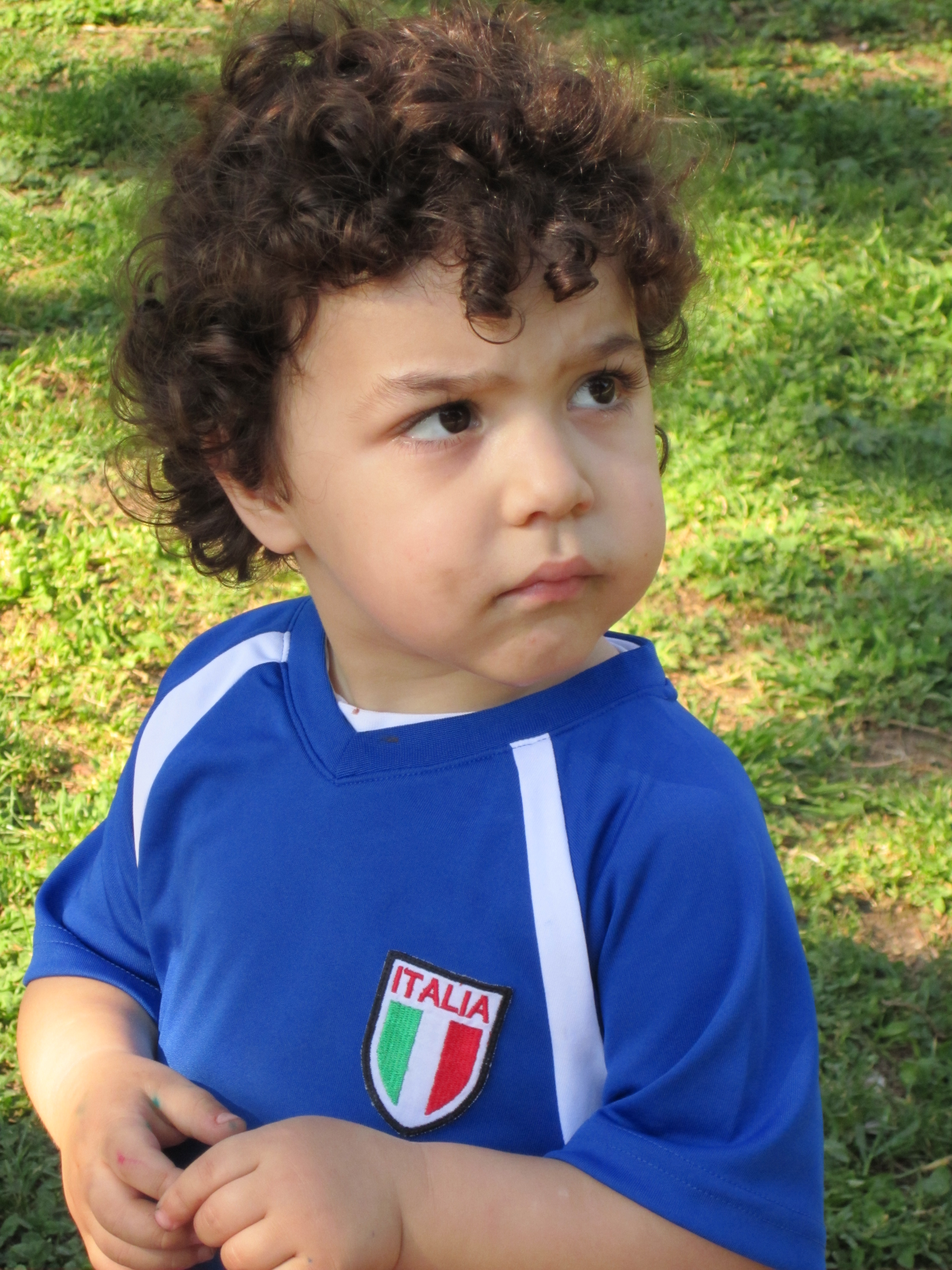
 It’s been eight years. Eight years since I moved to Italy and eight years since I watched the Azzurri, the Italian national soccer team, win the 2006 World Cup. I moved to Italy in June 2006. My destination was Rome. But due to some housing and adjustment issues, my first stop became Tuscany, to the small jewel of a town that is Cortona. Little did I know that one month after my arrival, this idyllic and somewhat conservative (it’s perfectly preserved wall is not a coincidence) hamlet would be rocking for days.
Azzurri means blue. And like the Inuits who distinguish the many kinds of snow with different words, the Italian language has many words for blue. This is understandable in a country that is a peninsula surrounded by several seas (Tyrrhenian, Mediterranean, Ligurian, Adriatic, Ionian). So it is no surprise that Rome has one of the deepest blue skies I have ever seen. And therefore fitting that the name given to the Italian National Soccer Team is the Azzurri.
When I arrived in Cortona I had no feelings whatsoever about calcio, the Italian word for soccer. Not understanding the language very well, I was often confused when I heard the word – What are they saying about “calcium” ? (The word means both soccer and calcium – being a linguist I am still trying to find a connection.) But as the Azzurri advanced in the games I found it hard not to take an interest when it was all anyone ever mentioned mornings in the bar, or along the parterre park during dog walks, or at the community pool in the heat of the afternoon. Then one day as I walked through a large piazza off the main street, I saw some men setting up rows of chairs. It was early morning and they were busy working before anyone had awaken. Che succede? What’s happening? I asked. “Lo schermo. Lo schermo.” The screen. The screen.
The next day the rows were meticulously positioned facing a giant screen that was attached to the wall of the Etruscan Museum. The town was buzzing – shops closed early and everyone was waiting to enter the roped-off area and get a seat. The first few rows were reserved for the elderly. Elderly? I didn’t know one elderly person back home who would have an interest in watching a sports game. But soon both women and men in their 70s, 80s and 90s, arrived to get a seat. Parents came with children, some just infants, as well as dogs and even the town’s stray cats were in the piazza. The gelato shop while normally closed on Sunday was opened. I was lucky. My good friend had secured several seats for his family and invited me to join them. Sitting among the Cortonesi, I watched the grandma in front of me put her hands over her eyes when the French player took a penalty shot. I saw fathers hold their children on their shoulders for two hours straight. And my own eyes kept wandering from the giant screen to the majesty before me – the lighted tower, the rooftops, the deep blue sky at nightfall, and the ancient cobblestones beneath me that made it hard to steady my chair. Lots of drama and a few not-so-proud moments of controversy, and the game was over. The Azzurri had won the World Cup. And Cortona, like all of Italy that night, did not go to sleep.
In the fall I moved to my new home in Rome and calcio became the white residue that covers every inch of my Roman apartment that comes in contact with the city’s water. Rome is famous for its running waters which flow non-stop from the fountains across the city. The water is brought to the city via ancient aqueducts and has an extremely high calcium content. (My friends are quick to tell me that although a nuisance, the calcium is the reason osteoporosis is rarely seen among Roman women. My introduction to soccer came on a Sunday afternoon when I was driving back to Rome from my gita (day trip) north. As I approached the toll both on the A-1, the major highway running the length of the country, the mass of cars stopping ahead of me hit me like a meteorite. What I failed to know was that everyone who had left the city for the day was trying to get back home in time for the start of Sunday’s game. I learned quickly. Any Sunday trip I took would be timed to return after the start of the game (when the highway is completely deserted).
While my first apartment in Rome was lovely, unfortunately it was located on an ambulance route to a nearby hospital. What this meant was that all times of day and night, blaring sirens could be heard from my apartment on the fifth floor (much louder than those in New York). The worst of course were the ambulances passing after I had gone to bed. But humans are amazing creatures and I was surprised at what one can get used to. As my neighbor confessed when I first complained of the noise, “The sirens bothered us too when we first moved in, but now I can’t fall asleep unless I hear at least three of them.” I chuckled, and waited for that day, or rather night to come. It never did.
Later that fall I had been under the weather. I went to bed a little early anticipating the noise and factoring it into the time it would take me to fall asleep. Quiet. Silence. More quiet. I tossed and turned. Where were the sirens? The next morning I learned that there had been a soccer match the night before. Then the following Sunday afternoon during another game, the same quiet. Could there be a connection? I often joke that should one ever have a heart attack, or be in dire need of an ambulance, make sure it is not during a calico game. This is a country where calcio is king. It has been the cause for missed weddings, birthdays, and many social engagements as well as divorce. The complaints of American football widows pale in comparison.
Upon a recent return to Rome from a trip to New York, I brought several gifts to my godson and his brother. One was some drinking straws I had seen in New York. They caught my eye because they were made of light blue (celeste in Italian) and white striped paper – the colors of Lazio, one of Rome’s two soccer teams. Their father is a big Lazio fan in a city where rivalries run hard and deep. Roma is the other team. (The way I phrased that — ‘the other team’– is going to get me in trouble.) The team is called the giallo rosso (yellow and red) which are its colors. In the Yankee-Met rivalry, Roma is the Yankees while Lazio the Mets. A few times a season they play The Derby, Rome’s subway series, only there is more fuel to this match since the two teams share a stadium during the season (During the Derby games one will neither hear an ambulance nor see a taxi.) When Adriano, age seven, saw the blue and white straws he immediately burst out, “Lazio!” Then the two brothers opened their other gifts – two colorful striped polo shirts. Suddenly Filippo, age four, was silent. “What’s wrong?” asked his mother. “My shirt is red, white and yellow,” he correctly described the wide bands of color and then dropped his head, “the colors of Roma.” Quickly his dad stepped in, “But this shirt has a little horse on it. See. It’s not a Roma shirt.”
But this week there is no giallo, no rosso, no celeste.
All is Azzurro.


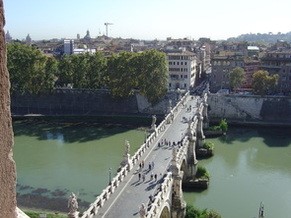

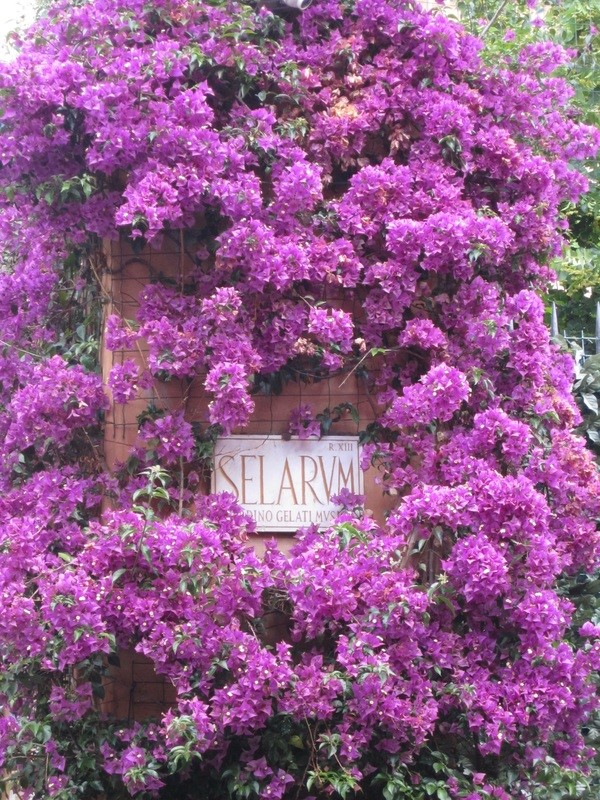
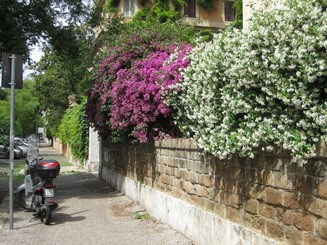

 The weather is perfect — 20 degrees C (about 70 F) and the skies are deep blue. Some puffy clouds come, but quickly go, and the pink, orange and yellow palazzi are competing for attention. Rome is vibrant. It is spring.
 boulevard was built by Mussolini to accommodate all the visitors descending on the basilica as well as exercise his power. Romans continue to lament over its construction which destroyed several of the old Borgo streets and displaced many people. In my opinion, approaching the basilica from the large boulevard takes away from the awe one feels when seeing the basilica through the spaces between the ancient buildings on the small narrow streets. Imagine when it was built walking amidst the craggy streets and then turning and coming upon the massive church. This was the feeling intended by Michelangelo and the other architects who designed it. A far more thrilling way to see the church. So if this is your first trip to St. Peter’s, I suggest you do not come upon it from Via Concilliazione but instead walk through the small Borgo streets where fruit vendors and flower carts still sell their wares. Come down Borgo Pio or Borgo Vittorio and make a few turns on the cobblestone, or sanpietrino as they are called, streets before seeing this great feat of architecture as they did in the 17th century.
 From the corner of Via Concilliazione and Via Traspontina take Via Traspontina towards the river. Pass a newspaper kiosk on your left and then turn right before the river at the church and hospital of Santo Spirito. Continue with the hospital on your right until you come to one of the busiest intersections in the morning — Piazza della Rovere. Be careful as motorcycles, city buses, and cars compete to the front of the traffic. I once saw a full city bus take the corner on its side, Romans bobbing up and down, as the driver blew a red light. Motorcycles will go around cars and drive into oncoming lanes just to get to the front of the traffic stopped at the light. You may want to take a few photos of the world’s most beautiful male and female police. The polizia and Carabinieri, the city and military police respectively, are positioned at this corner every morning directing traffic. (I’ve never seen either write a ticket although I’ve watched, as have they, many violations occur.)
 Turn right at the second alley. It will be a small street with a large set of stairs at its end. Take the steps up, slowly if you are not in the best of shape, to the street at the top and make a left. You will climb even more as you wonder how the cars stay in place on such an incline. At the end of this street is a beautiful church — Sant’ Onoforio. If you are lucky and the gates are open, go up the steps and enter the garden. The view is beautiful but an even better one awaits further up the Gianicolo. Go into the cloister on the right. The arched courtyard is incredibly tranquil (notice the young olive trees in terra-cotta pots) even though just outside the traffic is mounting during the morning rush hour. This week in the garden was a nun reading on a stone bench.
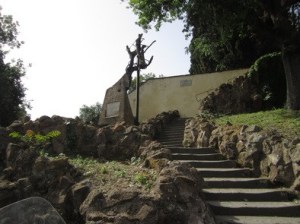 Outside the church, follow the winding road up the hill. This is the Passeggiata del Gianicolo. A famous children’s hospital Bambino Jesu is on the right. (The first children’s heart transplant using an artificial heart was performed here.) If you are ready for a coffee and something to eat Bar Tasso is a favorite hangout for doctors and hospital staff. Immediately after the hospital you will see on your left a set of steps and a broken tree. Take these steps up the Rampa della Quercia, or the Ramp of the Oak Tree. This is the tree under which the 16th c. poet Torquato Tasso was said to have rested. The tree is barely alive and a large branch remains secured to an iron holder. Continue to the top of the steps and follow the street along the view to the left. You will pass a tower and on the right an elementary school where if you are early on your walk you will see Roman parents bringing their kids to school many by motorcycle. And you may even have the pleasure of seeing a dog along for the ride, seated and balancing on the bike’s foot rest!
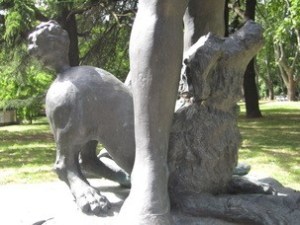 in a triangle. Walk left and take a small pebble path to your right. You will pass a small statue of a boy and a dog — A Righetto — dedicated to the children who were lost during the defense of the Roman Republic. The playful sculpture of the dog is one of my favorites. Turn left at the end of the path onto Viale Lorenzo Brunetti. Pass through a small arch and there will be a large arch in the Piazza San Pancrazio. This is a busy circle any time of day so be careful as you walk. (To the right will lead you to Villa Pamphili Park, the Central Park of Rome and well worth a visit.) Across the piazza is Bar Gianicolo. If you are daring and can navigate yourself across the many lanes, it is a favorite of Americans at the American Academy of Rome which is just around the corner (Tom Cruise and Katie Holmes had their rehearsal dinner at the Academy’s villa on the left behind the tall iron gates).
 main building on your right (fellows of the academy study here). At certain times the doors are open to the public. On the left is the garden. At the end of the street you can go left to continue down* or right and go about a hundred yards to the top of the street. The home of the American Ambassador to the Vatican City is on the left (the garden with its large stone urn is behind a fence). At the end of this street and to the left is a wonderful jewel of a park called Villa Sciara. *Going down to the left will bring you to the Fontone, or big fountain. This is a landmark seen in many Italian films, Last Night on Earth being one of them. Go around to the front of the fountain and again enjoy the view. Below is Trastevere, an old working class neighborhood which today has become popular with Americans living in Rome and on weekends it is filled with young Romans. Passing the fountain you will see a stairway down on the right. Go down the steps passing the Spanish Institute. [*Alternatively, If you have time you can go down on the other side of the fountain, further down Via Garibaldi, to the church of San Pietro in Montorio where you can enter the gate and see Bramante’s perfectly scaled Tempietto.]
 Garibaldi is behind ivy gates on the left, a compound with a small villa, artist’s studio, courtyard with orange and lemon trees and a resident dog named Tinto (dogs are welcome). Follow Via Garibaldi down to the intersection. Turn left at the bar and pass through the arch onto Via della Lungara which runs below street level and parallel to the river. The cobblestone street will have you holding in your tummy as the cars and buses squeeze by. At the end of the Lungara you will be back at Piazza della Rovere and can either cross the bridge on your right toward Campo dei Fiori or go straight to the Vatican (passing through the arch of Santo Spirito and the Borgo). If you are ready for lunch the Hotel Columbus (photo at right) in front of the church of Santo Spirito has a lovely courtyard restaurant.
 Here In Rome